

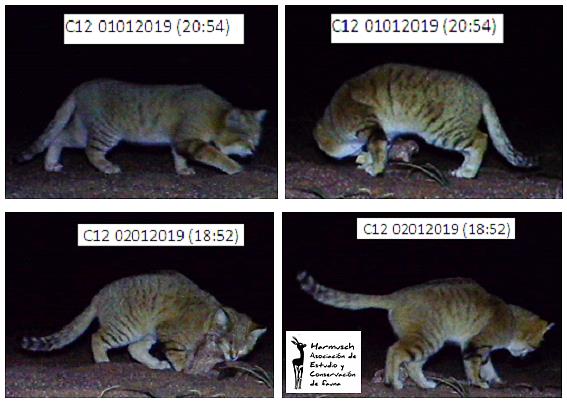
The sand cat (Felis margarita) is the only feline exclusively adapted to life in extreme desert ecosystems: the Sahara, the Arabian Peninsula, and the deserts of Central Asia. Its strictly nocturnal and elusive nature meant that, until recently, we knew almost nothing about its ecology in the wild. Harmusch has been studying it in the Moroccan Atlantic Sahara for over a decade.
This article summarises data published by Harmusch in the European Journal of Wildlife Research (2023) — the first in-depth study of sand cat ecology conducted in the Sahara, the species' main global stronghold.
A Unique Feline
Felis margarita is one of the world's smallest wild cats. Its pale, sandy-grey fur provides perfect camouflage on the reg plains and small dune fields where it lives. Its large ear pinnae act as low-frequency sound receivers, able to detect rodents and reptiles moving beneath the sand. Another extraordinary adaptation: it never needs to drink water directly, obtaining all its hydration from prey.
Although the IUCN currently classifies it as "Least Concern", scientific knowledge of the species remains very limited. Local population declines have been detected, and the species serves as a key indicator of arid ecosystem health: its presence reflects prey availability, habitat quality, and ecosystem integrity.
Where and How Did We Study It?
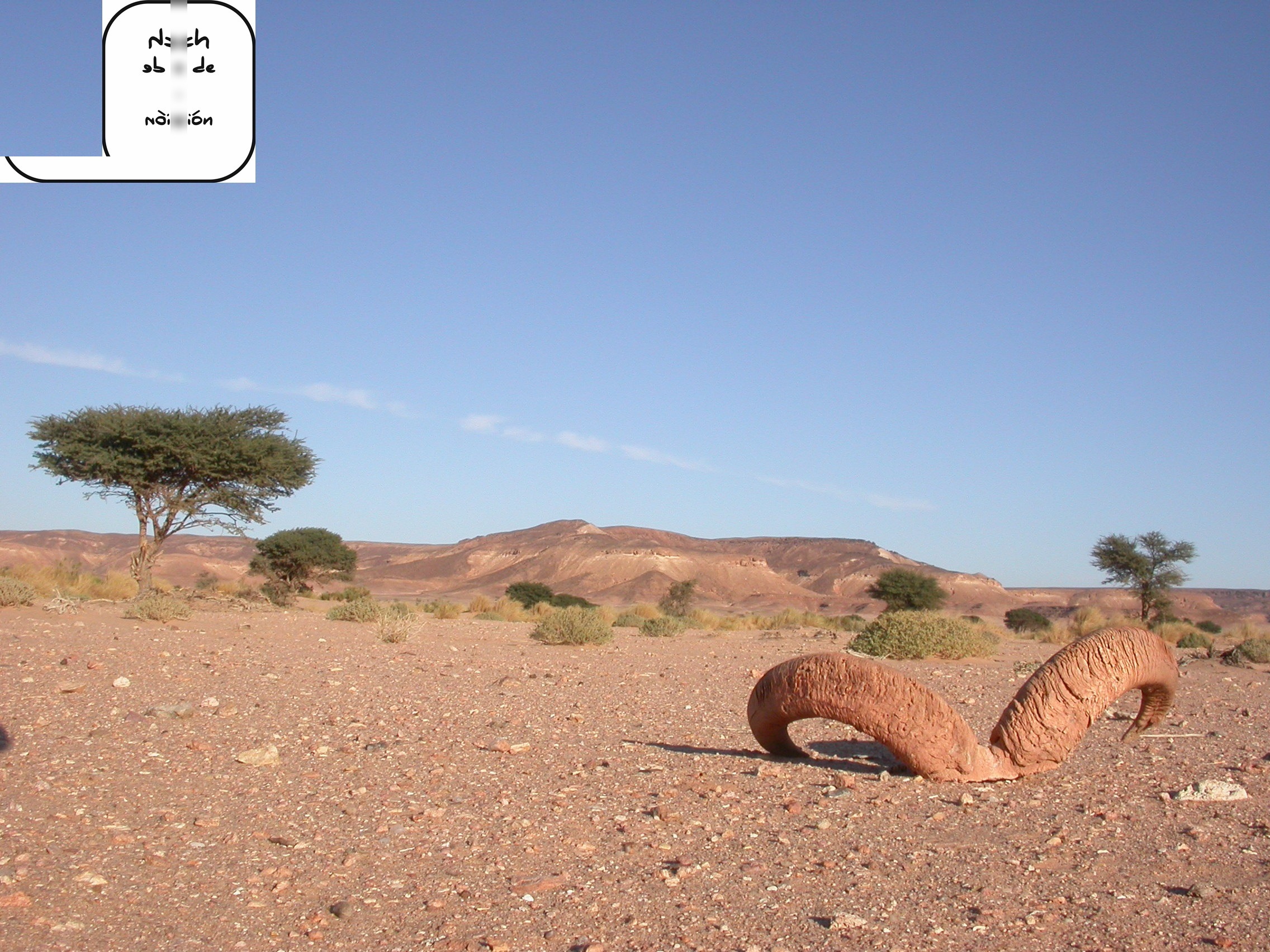
Harmusch's study area covers some 20,000 km² of the Atlantic Sahara, between the lower Draa River, the Aydar mountains, and the Seguia el-Hamra. It is a region of rocky hills interspersed with reg plains and hamadas, where open acacia savannahs (Acacia tortilis) persist along dry riverbeds.
Between 2012 and 2020, we deployed 224 camera traps with a total effort of nearly 20,000 camera-days, alongside foot transects totalling 2,490 km. To attract the cats, we tested an unconventional scent lure: Iberian lynx urine, which proved effective in 75.8% of detections.
What We Found
Strictly Nocturnal
Bimodal activity with two peaks: one at midnight and another 1–2 hours before dawn. Overlap > 78% with its main prey species.
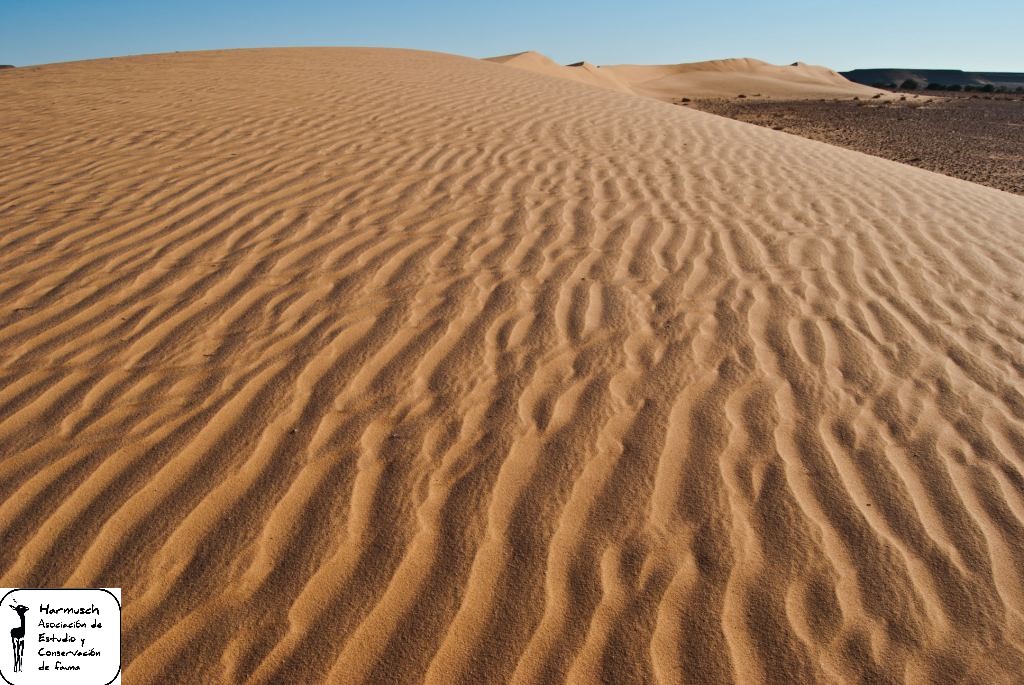
Habitat: Reg Plains
Only detected on flat sand-and-gravel terrain (regs and small ergs). Absent from rocky and mountainous terrain, indicating highly marked habitat selection.
Density: ~1 ind. / 100 km²
Estimation by spatial capture-recapture (SCR) in 2020: 1.12 individuals/100 km². Three males were identified in an intensive 100 km² area.
Individual Identification
The dark leg bands allow individual identification in 90.5% of photos, making photo-identification capture-recapture viable.
A key methodological finding was that foot transects completely failed to detect sand cat faeces. In 2,490 km of survey, not a single confirmed sand cat scat was found, despite cameras detecting the species within the first week. Tracks proved equally unreliable: wind erases traces rapidly and they are easily confused with those of the African wildcat (Felis lybica). The conclusion is clear: camera trapping is the only reliable method for studying this species in the Sahara.
Predator–Prey Relationships
Cameras recorded a total of 7,039 independent detections of wild mammals, including 1,960 records of lesser jerboa, 753 of Tarabul's gerbil, and other small mammals. Activity overlap between the sand cat and its potential prey exceeded 78% in all cases, confirming that this small felid hunts nocturnal rodents in the same time windows.
What About the Saudi Arabia Study?
Recently, a project at the Prince Mohammed bin Salman Royal Reserve (Saudi Arabia) managed to GPS-collar six sand cats, obtaining over 3,000 locations across 600 tracking nights. This work, published in the journal Quercus, provides unprecedented data on territory size, den use, and interactions between individuals.
The two approaches are complementary. The Saudi study employs intrusive methods (capture + GPS collaring) with substantial funding, while Harmusch demonstrates that non-intrusive methods can generate high-quality ecological data — density, activity, habitat selection — under far more austere logistical conditions. Our work in the Atlantic Sahara covers a study area roughly 200 times larger and has been achieved through self-funded expeditions, without the need to capture or handle any animal.
The use of Iberian lynx urine as a scent lure — a Harmusch innovation — proved highly effective and could be applied in future studies across other parts of the species' range.
Open Lines of Research
In December 2023, Harmusch installed new camera-trap arrays in the Betana region (Assa-Zag), exploring new potential areas for the species. The results of this expansion, together with genetic data currently being analysed, will help to understand the population structure of the sand cat in the western Sahara and its connectivity with eastern populations.
Felis margarita remains an enigma. But each camera-trapping campaign brings us a little closer to understanding how this small felid survives in one of the most inhospitable environments on the planet.
Reference
Gil-Sánchez, J.M., Herrera-Sánchez, F.J., Rodríguez-Siles, J., Díaz-Portero, M.Á., Arredondo, Á., Sáez, J.M., Álvarez, B., Cancio, I., de Lucas, J., McCain, E., Pérez, J., Valenzuela, G., Martínez Valderrama, J., Sánchez-Cerdá, M., Lahlafi, T., Martín, J.M., Burgos, T., Jiménez, J., Qninba, A. & Virgós, E. (2023). Applications of non-intrusive methods to study the sand cat: a field study in the Sahara Desert. European Journal of Wildlife Research, 69, 20.