

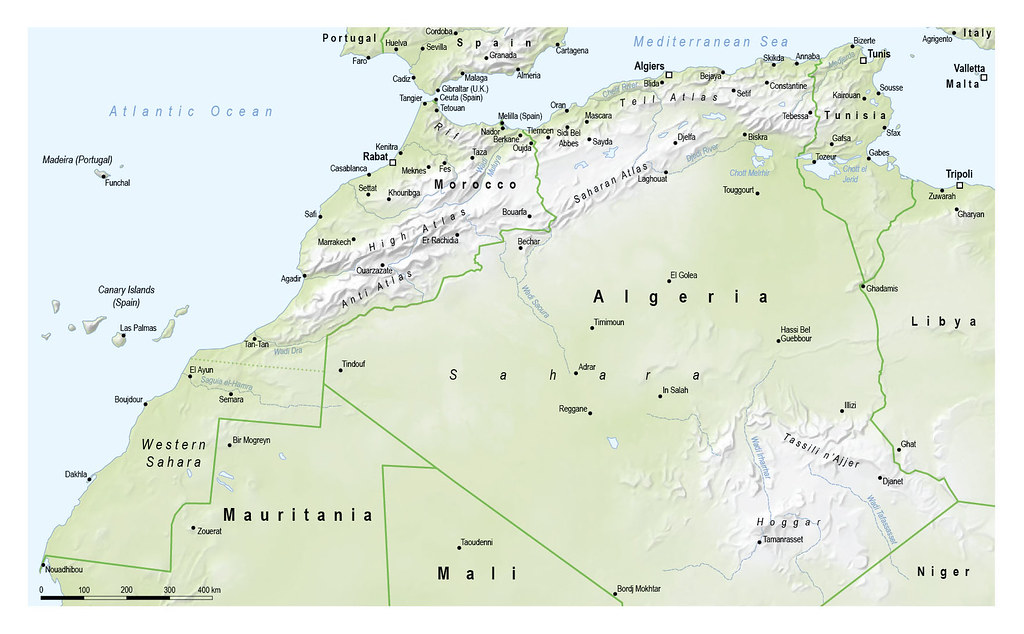
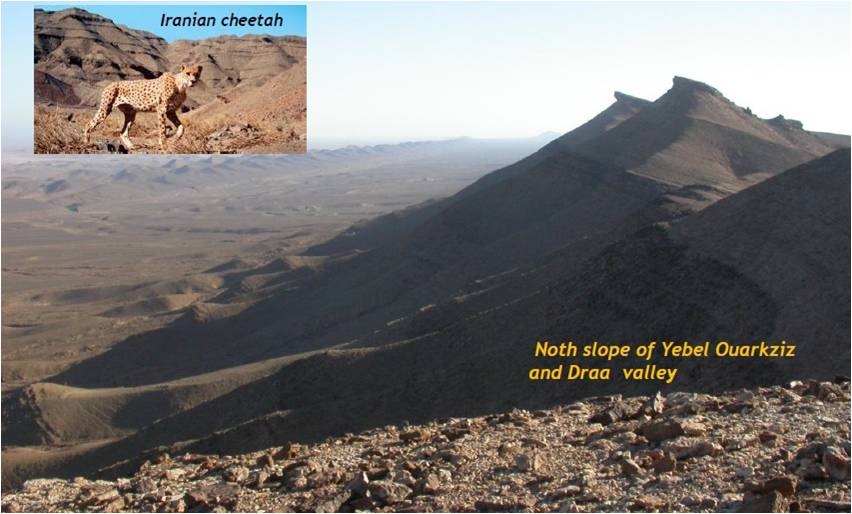
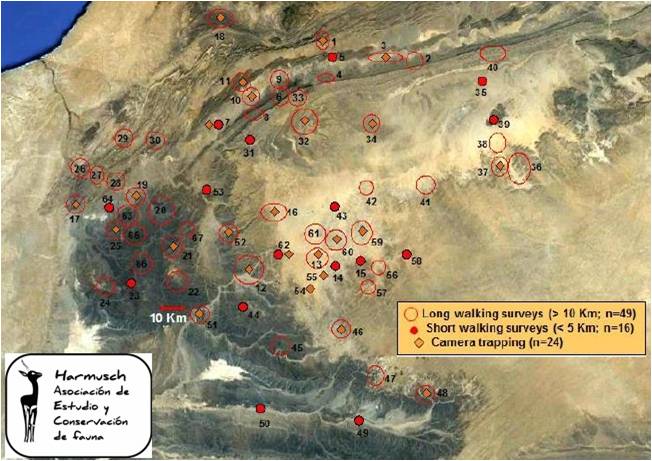
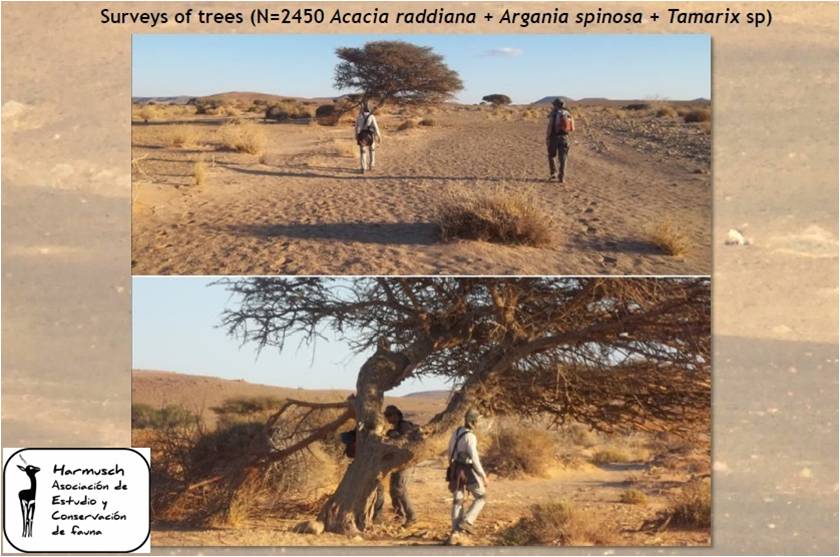
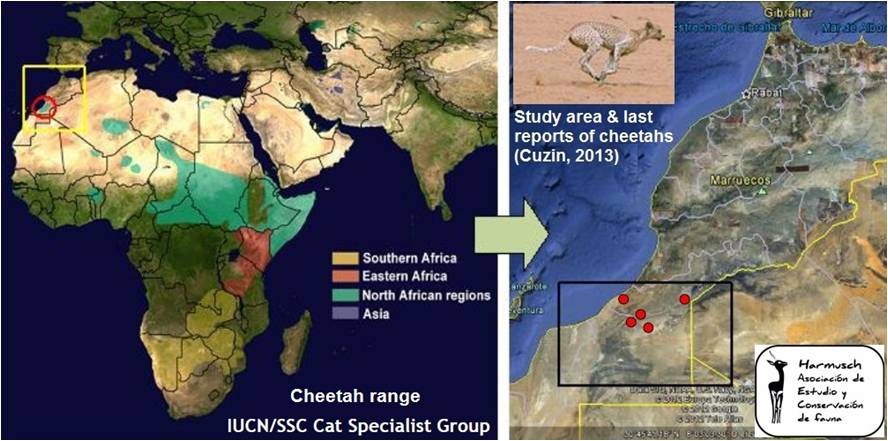
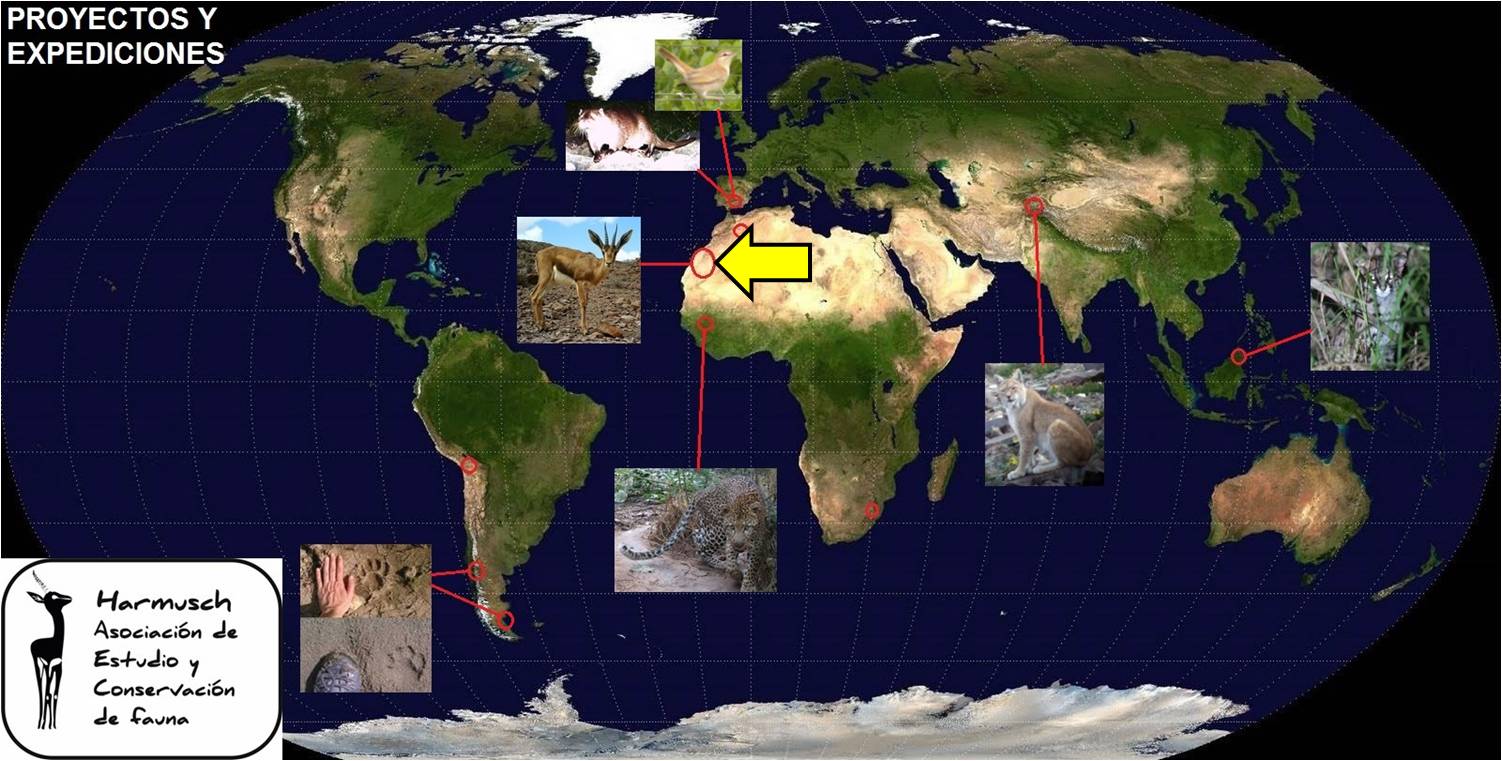
The Saharan cheetah (Acinonyx jubatus hecki) was present in Moroccan territory until the early 1990s. The last records were reported in the lower Draa River and Jebel Ouarkziz, and although no specific survey has ever been carried out, the IUCN currently considers the cheetah extinct in Morocco, including the Atlantic Sahara. As part of a future long-term study in collaboration with the High Commission for Water and Forests and Combatting Desertification of Morocco and with the Institut Scientifique de Rabat, Université Mohammed V (Dr. Abdeljebbar Qninba), between 2011 and 2014 members of Harmusch carried out a preliminary cheetah survey in the Lower Draa River region, Jebel Ouarkziz and the Aydar Mountains, within the area considered by the IUCN as the last refuge remaining west of the Algerian population (currently the most important for this subspecies). It is a Saharan region with some Macaronesian elements, covering about 20,000 km2 and located on the northwestern edge of the Sahara. In ten self-financed expeditions, all habitats present in the area between the lower Draa River, the Aydar Mountains and the Sequiat Al Hamra were surveyed. During the sampling, droppings on large trees were specifically searched for, especially acacias and tamarisks (n=2450 trees), since this is the most effective methodology for detecting Saharan cheetahs. Tracks were also intensively searched for on suitable substrates, such as muddy riverbeds and sandy areas (more than 1500 km on foot), and 80 camera traps were deployed for a total effort of 330 camera-days. Finally, field interviews were conducted with several local inhabitants, usually nomadic shepherds who move throughout the territory.
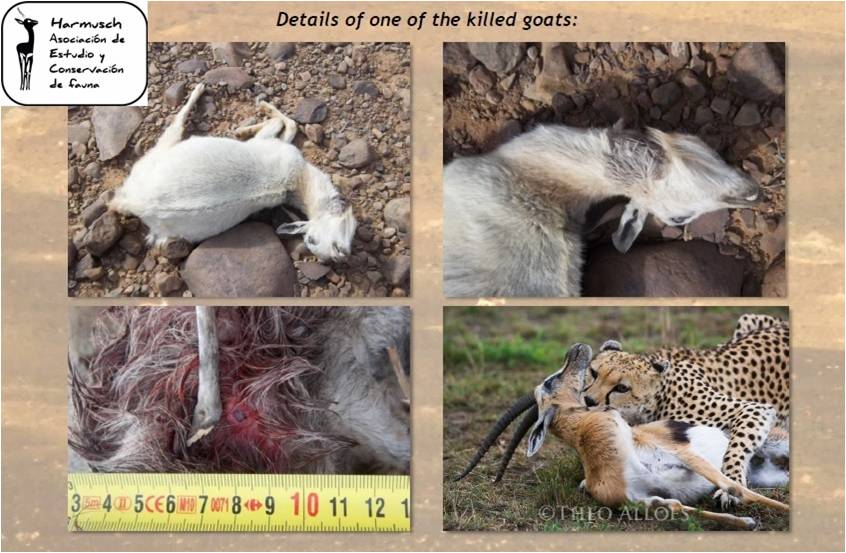
The information obtained has not been able to confirm the presence of cheetahs with certainty, although some evidence was found suggesting the likely existence of individuals; in particular, during the foot surveys three dead goats were found according to cheetah modus operandi (asphyxiation by a sustained bite to the throat while the prey is held against the ground) and remains of two Cuvier's gazelles (Gazella cuvieri) that had been consumed. The camera-trapping effort was insufficient, since recent research has shown that at least 1000 camera-days are needed to detect cheetahs in Saharan environments. All interviews yielded negative results, although negative responses were also frequent for other carnivores that are undoubtedly present today.
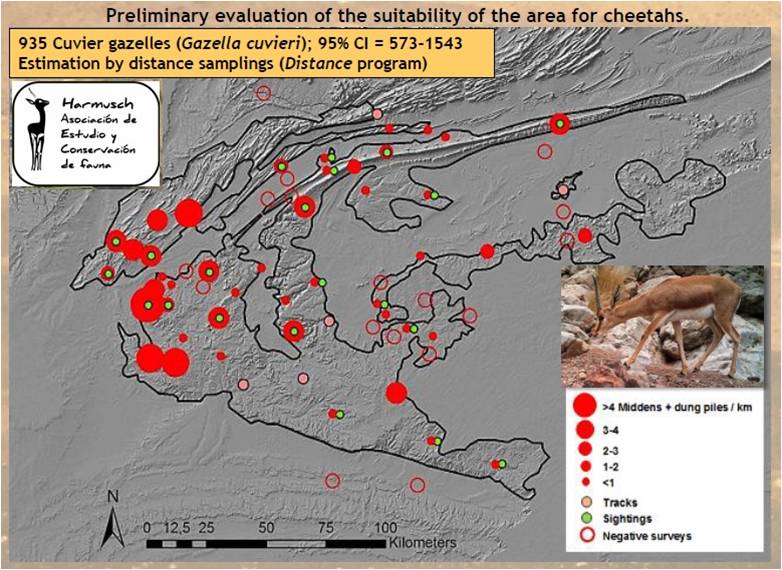
The data have clearly shown that this area is one of the most diverse and probably one of the richest in carnivores and wild ungulates in northwestern Africa. For the first group, we detected twelve confirmed species and two possible ones (the cheetah and the caracal Caracal caracal). The golden jackal (Canis aureus), the red fox (Vulpes vulpes), Rüppell's fox (V. rueppellii) and the North African wildcat (Felis libyca) are the most common species, detected at between 73.5 and 88.6% of sampling points. The honey badger (Mellivora capensis) and the common genet (Genetta genetta) were widely distributed but apparently low in abundance, detected at 35.8% and 26.4% of the points, respectively. The fennec (V. zerda), the slender mongoose (Galerella sanguinea), the Egyptian mongoose (Herpestes ichneumon), the Saharan striped polecat (Ictonyx libyca) and the sand cat (F. margarita) showed distributions restricted to specific habitats and were scarce in the study area, appearing in between 1.8 and 15.1% of the surveys. Finally, the striped hyena (Hyaena hyaena) was found to be distributed but very scarce, at 11.3% of the points. Particularly interesting species include the slender mongoose (detected for the first time in the Palearctic) and the sand cat (first local confirmation). Specific surveys for otter (Lutra lutra) were also carried out in the Draa and Chebeikia rivers, with negative results. As for wild ungulates, the Cuvier's gazelle was recorded at 75.4% of the sampling points, with 58 individuals observed and 4 photographed by the camera traps; an abundance estimate was carried out using the Distance program, yielding a density of 0.08 ± 0.02 individuals /km2 and a total population of 900-1000 individuals (estimated range 573-1543). Therefore, the survey confirmed this population as the most important worldwide for this threatened species, endemic to the Maghreb, and one of the three species of the genus Gazella classified as endangered by the IUCN. The western dorcas gazelle (G. dorcas neglecta) and the Saharan aoudad (Ammotragus lervia sahariensis) were located at 13.2% and 20.7% of the points, respectively, although the information obtained was not sufficient to calculate density estimates (8 and 4 individuals observed, respectively). The North African wild boar (Sus scrofa barbara) was found at 15.1% of the points, right along the margins of the Draa and Chebeika rivers.
The estimated availability of ungulates, together with the abundance of hares, show a suitable scenario for cheetahs from a trophic point of view if compared with the situation of populations in Iran; if the density found in the Sahara, specifically in the Ahaggar (0.21-0.55 ind. /1000 km2), is extrapolated, the estimated carrying capacity would be very low, between four and eleven individuals. In other words, it would be an unviable population, probably in a pre-extinction phase at best. However, the study area is not isolated from other extensive potential unsurveyed regions, which could also explain the likely presence of cheetahs in this area. On the other hand, the surveys have revealed significant pressure from poaching, a circumstance that undoubtedly constitutes the main local threat, both because of the direct risk and because of the removal of gazelles.
In the work with ungulates, the participation of the Centro de Investigação em Biodiversidade e Recursos Genéticos (CIBIO) and the Estación Experimental de Zonas Áridas (EEZA) has been fundamental, a collaboration that has led to important findings in demographic genetics, among which the great diversity of the Cuvier's gazelle population and the discovery of a new haplotype of the western dorcas gazelle stand out. Likewise, we have made considerable progress in understanding the biology of the Cuvier's gazelle, providing previously unknown data on its demography, habitat selection and feeding. In fact, Harmusch is collaborating with the IUCN on the drafting of the Cuvier's gazelle conservation strategy. Finally, our thanks to Paulo C. Alves (CIBIO) and Anne Schmidt-Küntzel (Cheetah Conservation Fund), who genetically analyzed the doubtful cheetah samples.
Keywords
Methodology
- Track analysis: Survey of 2450 trees (mainly acacias and tamarisks)
- Survey routes: 1500 km of visual searching
- Camera trapping: 80 camera traps (330 camera-days)
- Interviews with local population: Interviews with nomadic shepherds in the region
- Expeditions carried out: 10
Results
- Cheetah status: Presence was not confirmed, although signs were found (three dead goats according to cheetah modus operandi and remains of two Cuvier's gazelles)
- Carnivores detected: 12 confirmed species (e.g., golden jackal, red fox). The sand cat (Felis margarita) was identified locally for the first time
- Ungulates: Cuvier's gazelle is the most abundant species with an estimated 900-1000 individuals, making it the most important population worldwide
- Threats identified: Poaching as the main threat
Collaborators
- CIBIO
- EEZA
- Scientific Institute of Rabat
- Rey Juan Carlos University
Derived publications
- (1) Gil-Sánchez, J.M., Qninba, A. & Virgós, E. (2014). Results of a survey of wild ungulates in lower Draa valley, yebel Ouarkziz and Aidar massif, Morocco. 13th Annual Sahelo-Saharan Interest Group Meeting. May 1 – May 5, 2013, Agadir, Morocco.
- (2) Díaz-Portero y otros autores (2013). Situación de los mamíferos carnívoros en el Bajo Draa, Yebel Ouarkziz y Montes Aidar, Marruecos. XI Congreso de la SECEM. 5-8 diciembre, Avilés.
- (3) Arredondo, A. y otros autores (2013). Situación de los ungulados silvestres en el Bajo Draa, Yebel Ouarkziz y Montes Aidar, Marruecos. XI Congreso de la SECEM. 5-8 diciembre, Avilés.
- (4) Gil-Sánchez, J.M. y otros autores (2013). ¿Quedan guepardos en Marruecos? XI Congreso de la SECEM. 5-8 diciembre, Avilés.
- (5) Herrera-Sánchez, J. F. y otros autores (2013). Evaluación del muestreo indirecto para la detección del ratel (Melivora capensis) en medios saharianos. XI Congreso de la SECEM. 5-8 diciembre, Avilés.
- (6) Álvarez, B. y otros autores (2013). Primeros datos sobre la alimentación y selección de plantas por la gacela de Cuvier (Gazella cuvieri) en un hábitat natural (Montes Aidar, Marruecos). XI Congreso de la SECEM. 5-8 diciembre, Avilés.
- (7) Gil-Sánchez, J.M. y otros autores (2014). Preliminary data on the status and biology of the Cuvier’s gazelle in the Sahara range of Morocco. 14th Annual Sahelo-Saharan Interest Group Meeting. April 30 – May 2, 2013, Vila do Conde, Portugal.
- (8) Gil-Sánchez, J.M. y otros autores (2014). Mammalian carnivore survey results from the lower Draa valley, Yebel Ouarkziz and Aidar massif, Morocco. 14th Annual Sahelo-Saharan Interest Group Meeting. April 30 – May 2, 2013, Vila do Conde, Portugal.
- (9) Asociación Harmusch (2015). Tras los pasos de Valverde: expediciones al Sahara Occidental. Quercus 348: 26-32.
- (10) Gil-Sánchez, J.M. y otros autores (in rev.). An evaluation of methods for surveying the endangered Cuvier’s gazelle (Gazella cuvieri) in arid landscapes. Journal of King Saud University (Science)